Thursday, 24 January 2019

Development Discourse _ Bharatiya Perspective

There is beautiful movie “Gods must be crazy” picturized around the tribal community in Africa. The movie shows how an empty coca-cola bottle dropped from a chopper gets into the hands of the tribals. With the coming of an object from so called modern world, the peace and order in the tribe is destroyed. Although they find the unbreakable glass useful, it becomes the reason of their fight and animosity.

This has become exactly the case of development today. Nobody is saying soft drinks are anti-development. It is equally wrong to say that having a soft drink itself shows the level of development. Soft drinks are a measure of standard for the community in which the pilot lives; the tribals have a different standard. Not one template of development can suit all communities, cultures, Nations and people. Universalization of anything can have miserable ends.

Today, when we talk of development, we are only talking about economic development; in other words wealth creation. A satire goes like this -
Development today means:-

  1. Vertical development - of concrete buildings, industries etc.
  2. Horizontal development - of human fat through the sedentary lifestyle.
What about intellectual, emotional, spiritual development?
Further, is economic development justified by pollution and damage to atmosphere.
It is high time to think, what development actually means to the humanity at large.
Can we give a Bharatiya way to address this issue? Do we have an answer in our age old culture? The answer is yes. Let us look into it.


Popular view of development
  • Fulfillment of basic needs - food, clothing, shelter.
  • Wealth creation. 
  • Industrial development
  • Economic progress. 
  • Human well-being


Image result for industrial development


Fault lines in the popular view
  • Exploitation of environment:- industrial development has led to grave challenges like environment pollution causing threat to flora and fauna. It is also causing human illness. That which was started for human well being is not ensuring that itself.
  • Centralized governance:- in all modern means development is centralised. In capitalism, economy is in the hands of a few. In Socialism, it is in the hands of government. Governance, in both the cases is centralised.
  • Technology Transfer:- With increasing stress on Intellectual Property Rights (IPRs), knowledge is also restricted to a few. Transfer of technological knowledge is restricted.
  • Imbalance in growth:- a few city centres are given focus and remote villages are ignored.


Let us now look into the Bharatiya view of development.
Bharatiya perspective
Environment centric:- all our technologies are environment friendly. For example organic - cow based farming. Cottage industries ensure distribution of output, rather than large scale production causing damage to environment in industrial areas.


Decentralisation: In Bharat, businesses are primarily run by families. Generations after generations the technologies of metallurgy, architecture, Vedic / Spiritual Knowledge, have been transferred through the family system.   


Self governance:- Grama Swaraj & the panchayat system of self governance is an ideal system wherein local issues are addressed locally. Systems centred around a single place, or a group of people cannot confront the challenges in far off places. For example people sitting in a remote village in Nagaland will get better solutions locally than from lofty suggestions of experts sitting in Delhi.

Image result for village self governance


Temple economy:- Temples in Bharat have not only been places of religious worship, but also centres of economy. Many people have and are making a livelihood out of the temple viz. the architects, priests, flower vendors, caterers, service sector, artists, etc. 

Image result for hampi stone chariot
Stone Chariot at Hampi (It is said diamonds and pearls were traded in & around this place). 


Gau Mata & Organic Farming:- Cow is the center of Bharatiya culture and economy. Cow is worshiped as mother; she is also sine qua non for agriculture in Bharat. Pesticides used in farms have destroyed the fields and the lives of people living in and around the agriculture areas. Whereas, some researches have proved that even pesticide free organic farming can yield rich dividends. Cow manure is known to enrich the quality of soil and thereby the crop. The presence of cow in farm land has multiple benefits.


Dharma : Holistic Vision A holistic vision is what is needed for anything subject to see it's peak. As seen earlier, there are certain weaknesses in the present discourse of development. In fact, destruction of environment and spoling human health cannot be termed as development. In Bharatiya vision we have a complimentary approach :-


  1. परम वैभवं - Reaching the pinnacle.
  2. सर्वे भवन्तु सुखिनः - May all be happy.

Image result for dharma

Hence, economic accomplishments may not be at the cost of something else. Reaching the glory or development in another sense is all inclusive. “Inclusive Development” is the Bharatiya model of development. Inclusiveness is not just of all the segments of human society; it includes plant life, animal life and the environment at large. Only a person with such an inclusive vision can create technology that is eco-friendly, at the same time immensely beneficial to mankind. This is Dharma - attaining the crest/peak by fulfilling one's duty, at the same time including inclusive development of all along with individual self development of a human being.

This vision can be inculcated only through sanskaras (values). These values must be inculcated from childhood so that each individual blossoms into a contributor rather than an exploiter.


#DevelopmentDiscourse

Sunday, 21 January 2018

Interstellar: A case evidencing that knowledge of West is slowly moving towards Vedanta


Recently I watched the movie “Interstellar” and I felt the same thing what many of you might have felt as you read this post, “Why this late?” Be rest assured that anybody who comprehends the movie will definitely be awestruck. Naturally, I too was! But what is interesting is that, the more profound the knowledge, creative thinking, and science of the west gets, the more closers it comes to the Hindu Philosophy. The finer the concepts of metaphysics becomes, the more closer it comes to the Vedanta.
The importance attached to the planet Saturn (शनि), in the movie, with regards to space time is deeply rooted in the Hindu thought.

Image may contain: night

Apart from this, two other important aspects from the movie seem strikingly similar to Vedanta, Puranas, etc.
1. Life and age of beings on different planets of various solar systems, and galaxies:
One may say science knows this all along that every minute spend by any being on earth is more than or less than the very same minute to be spent on another planet. This influences the age or the lifespan. This phenomenon as I understand is chiefly due to varies rotation, and revolution cycles, which in turn is influenced by distance and gravity.
In the movie, 1 hour spent in an unknown planet is equal to 23 years of human life spent on earth. Such fantasies (who knows if it really exists) and many more are plentifully available in our Puranas.
The Puranas always said that the lifespan of higher beings in other Lokas (Planets/Galaxies or whatever you call it) are more than that of Humans. In the Bhagavata Purana for example, Pruthu Raja and his daughter spent just an hour in Brahma Loka, where the TretaYuga is complete and the New Dwapara Yuga is also under the verge of completion. So one hour in Brahma Loka plus the to and fro travel from earth takes almost 21,60,000 years of human life on earth. So many generations of human life goes extinct while one spends an hour in Brahma Loka. Many Hindu texts, including the Manusmruti record the concept of time from the rudimentary level through human life span, to that of Devatas, through again to the life span of Brahma.

No automatic alt text available.

2. Metaphysics: Abstract concepts of space, time, gravity, etc.:
When the hero enters another dimension in the universe, he realizes that he himself is interacting with his own being/self in another dimension in which the earth exists. The hero says, “They have access to infinite time and space (in the 5th dimension), but are not bound by anything”. The concept of "Jnana" & "Vairagya" may also be observed here.

Image may contain: indoor

The hero is unaware that he is not the one doing things. The voice says, “People could not build this (dimension beyond space time). It was them”. (The upanishadic concept of “तत्” is portrayed here). Everything is that! Thou art that! (तत् त्वम् असि|)

Image may contain: indoor
Everything is his play (लीला).

Sunday, 14 January 2018

True remembrance is in fulfilling the unfinished dream of a Rishi

It has been 154 years since Swami Vivekananda visited this planet and ever since his name instills waves of current in all those who have read or heard about him!

Image may contain: 1 person, standing

The magnanimity of the persona is such that even after 154 years, the very same words of his, ushers infinite energy unto every human. From Bharata to the America in the west; to the Japan in Far East, his influence has been immense.

The life of Swamy Vivekananda is very intense and dynamic. To read and know him is to understand many facets. It seems as though that he has spoken about all those things that needs to be spoken. His life is an inspiration to all! Many persons, institutions, and societies have be set up and are blossoming on account of his words. He was the inspiration behind many revolutionaries during the freedom struggle.
Subhash Chandra Bose said these words about Swami Ji "He is a full-blooded masculine personality".

From a universe of Swami Vivekananda, I see two of his messages, as a part of his idea of education, as very important ones:-
1.  Character Building
2. Man-Making

Swami Ji said, “Education is not the amount of information that we put into your brain and runs riot there, undigested, all your life. We must have life building, man making, and character making assimilation of ideas. If you have assimilated five ideas and made them your life and character, you have more education than any man who has got by heart a whole library”.

The word character is used here in the sense of “शिला”! The word sheela has an interesting meaning. Sheela is not jus honour, but character. He whose thought, words, and actions are in union is “शीलवान” (sheelawan). Now when thoughts are filthy and words are sweet, he is a character-less person, and vice-versa. Even when words are foul and actions are right, the course is not correct. That is education which directs a human in the path of building his “Character”. To build a swabhava (sheela) of union in thought, words, and action is the goal of education.
Man making may mean three things, and I think Vivekananda used the word in all the senses. 
1. Manliness meaning courage, strength, valour, etc. 2. Nurturing the potentials of a human being which leads to the distinct identity of humanity from the other species on the planet. 3. Fostering “samvedana” without which a human is nothing but a wild animal or a devil.

Manliness
All through our history, we see stories of courage, strength, and valour. Bhima and other warriors, it is said, had arms as big as the bark. We hear stories of Samarth Ramdas ji who used to practice 1200 Surya Namaskaars a day. The feats of all our kshtriyas since time immemorial and even through the independence movement, and the valour displayed by our soldiers in the borders even today, are all but representation of the culture of valour in our Nation.

Human Identity
The ability to think rationally, and to address a single problem/situation in a hundred different ways is a unique a gifted potential of a human. Puranas say that Manushya Janma (Human Life) is begotten after Punya (Good deeds/merit) of many lives (Janma). This opportunity to explore  the infinite potential and expand likewise is all that is to be a human. To expand the vision and capabilities of self is an opportunity and every human being gets.

Samvedana
Vedana is the pain of the physical body. Samvedana is feeling the pain of others as ones own. The Rakshas (devils) do not see the pain of others. In fact, Schadenfreude is the exact opposite nature of a human being. To expand the identity is samvedana.
Let strength and valour be our two hands, and character and morality be the two legs. Standing on these 4 limbs a man is bound to excel in life.

He also stressed on Physical Education “You will be nearer to Heaven through football than through the study of Gita. You will understand Gita better by your biceps, your muscles a little stronger. You will understand the Upanishads better and the glary of the Atman, when your body stands firm on your feet and you feel yourself as man.”

Swami Ji has expressed on many occasion that the purpose of his life was to serve the lotus feet of Bharata Maata. He was the first person to call for the Worship of Bharata Maata and to leave all other Gods and deities for a few years. The slogans “Bharat Maata Ki Jai” and “Vande Mataram”, and consequently the revolutionary freedom struggle were all inspired from Swami Vivekananda.  
On another occasion he said,"…the land where humanity has attained its highest towards generosity, towards purity, towards calmness, above all, the land of introspection and of spirituality - it is Bharat”.
For Bharat as a Nation, to reliaze his dream of Bharat becomming the "VishwaGuru" is the ultimate Motto.

Remembering a Rishi means to become like him or to try to fulfill his unfinished dream. WE must all work towards making Bharat Maat the vishwaguru, then alone we will have paid a proper tribute to Swami Vivekananda. शिवो भूत्वा शिवम् यजेत्|

वन्दे मातरम|

 Image may contain: 1 person


Sunday, 3 December 2017

Zoroastrianism and the Vedic Culture

   
Ahura Mazda (The god of Zoroastrians).

     The Zoroastrian religion has so many comparables to the Hindu/Sanatana Dharma. So much so that one feels, Zoroastrianism is the part of the greater family of Hinduism including Jainism and Buddhism.

      The God of the Zorastrian is called "Ahura" (Closer to Asura of the Hindu Scriptures) and the enemies are called "Daeva". Probably the older days (Pre-Islamic) wars/conflict between north-west part of Bharat and Persia (now Iran) was termed as Deva-Asura battle.

      Nevertheless, Ahura sits on a thing that looks like eagle which is similar to Mahavishnu being seated on the Garuda.

Mahavishnu on the Garuda.


      The holy scripture of Zorastrians is known as Avesta. The other name of Avesta is Aveda (Sounds very close to the word "Veda").

      Other than Ahur, the Zoroastrians revere demigods or angels called as "Yazatas" (Sanskrit equivalent being Yakshas).

     The main worship ritual of the Zoroastrians is called the Yasna or the Sanskrit form "Yajna". The Yasna has three main fires that are protected and worshiped, namely:-
1. Atash Adaran
2. Atash Behram
3. Atash Dadgah

In Yajna too there are 3 fires.
1. Avahaniya
2. Garhapatya
3. Dakshina

Yasna ritual by three priests representing the three fires.


      The entire process of Yasna is similar to our rituals starting from shuddhi, inviting/invoking deity to completing the worship.
Similar to the pancha bhootas mentioned in Hinduism, Avesta mentions of 5 elements:-
1. asman (sky)
2. Zamig (earth - also Zamin in Urdu/Hindi)
3. xwarag (Fire)
4. ab/apas (Water)
5. wad (air)

      Also cattle (called as gospand equivalent to the Sanskrit "gov/go - गौ/गो) are revered in Persian texts.

The Persian Empire at its peak.


      The gahambars or the festivals they celebrate too are similar to the festivals in Hinduism.
No wonder Will Durant said, “India was the motherland of our race, and Sanskrit the mother of Europe's languages: she was the mother of our philosophy; mother, through the Arabs, of much of our mathematics; mother, through the Buddha, of the ideals embodied in Christianity; mother, through the village community, of self-government and democracy. Mother India is in many ways the mother of us all".

Spoils of Malik Kafur


Image result for padmanabhaswamy temple
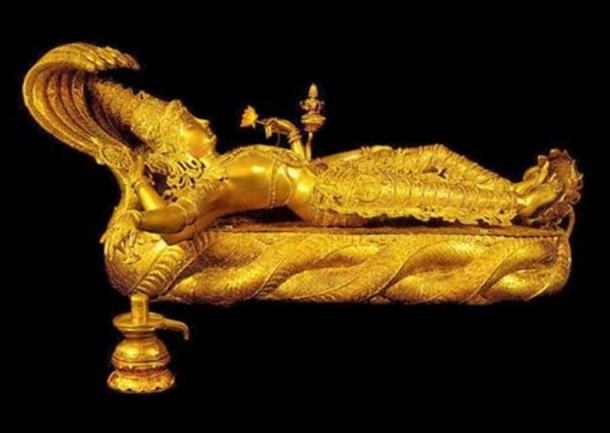
Anantapadmanabha carved out in pure Gold.
Malik Kafur was a trusted General of Alauddin Khilji. He was among the most ruthless men who murdered all and sundry and plundered temples after temples. In 1311 he invaded the Pandya and other Southern Kingdoms. None of the Kings accepted to be subordinates of Alauddin Khilji. Bloody wars ensued and large scale plundering took place. It is said that Malik Khafur, after plundering the temples of Madurai and other surrounding cities and also the treasury of the Pandya King, took along with him 17,28,000 kgs of Gold, several hundreds of chests of jewellery and pearls (Estimates say about 9000 Kgs), 612 elephants, and 20,000 horses.
Representative picture of Malik Kafur

He further plundered Dwarasamudra and Warangal. In Dwarasamudra, famously known as Halebidu, he looted around 10,88,621.688 kgs of Gold (24,00,000 lbs). It is said that Kolar Gold fields was the major mine for all the surrounding states.
This I write not blindly. Marco Polo from Italy (13th Century before Malik Kafur) and Abdul Razak from Persia (15th Century after Malik Kafur's invasion), write on countless gold, jewellery, and gems that were accumulated by Bharatiyas in those times in the Vijayanagara, the Pandya and other Kingdoms. In fact, Marco Polo says, "The sons of the kings (in Bharat) do not spend the gold, jewellery, stones, and other treasures. They not only preserve it as their ancestral pride (as respect also), they build their own treasure to pass it onto the upcoming generation".

Treasures in temples of Ancient Bharat.
(No wonder we see immense treasure in temples like Padmanabhaswamy temple in Kerala).

#KnowHistory
#DoNotForget_DoNotForgive

Monday, 27 November 2017

Problems and the way to success!


“In a day, when you don't come across any problems - you can be sure that you are travelling in a wrong path” - so says Swami Vivekananda.

This quote may be easily misunderstood. In a sense, one may conclude that coming across problems itself is the right path. A negative connotation to this meaning is quite possible.

Convenience or luxury can never be the way to excel in life. Look at the life of a moth or a butterfly for that matter! In its initial stage the caterpillar faces a lot of hurdles and troubles to survive. It lives on eating leaves. Many predators haunt it! Then it goes into a cocoon and undergoes immense pain in the metamorphosis. But what ultimately comes out is a beautiful butterfly!

All those who have excelled and accomplished something in life have also been through immensely difficult times. Look at the life of Swami Vivekananda itself. Poverty struck his house after his father expired. Many more personal tragedies and he had to leave her mother alone to serve the motherland. His personal health too has not at it's best. He suffered from various physical ailments. Yet, none bothered him. He lived on for days without any food or shelter in the extreme cold of America. He suffered lot of apathy! Yet, he emerged as a Hindu Monk being a champion of Universal brotherhood.

Further, for excelling souls, whatever and how much ever great things one does in a day, there is always a quest to do more and more great things. When one enjoys life, it flies away, and when one is sorrowful, it is one hell of a life. For those who are on the right path, the eagerness to do something more, do good, and use the time more productively is always present. It is but naturally to find obstacles on the path too excellence.

Look at the river! What turns and terrains must it cross! How many big rocks it has to face! Mountains too cannot stop the march of a river. Whatever may be the hurdles, the rivers always touch it's destination (the ocean).

Remember, “In a day, when you don't come across any problems - you can be sure that you are travelling in a wrong path”. But there is no need to get dithered by the problems. One has to face it, and face it boldly. That is way to success! I'm Swamiji's own words, “Arise, Awake, and Stop not till the goal is reached”!

#125YearsOfChicago
#SwamiVivekananda
#Quotes

Remembering Ambedkar Ji's words on the Constitution Day


On 26th November, 2017 we celebrate as Constitution Day, as this day on 1949 the Constituent Assembly adopted the Constitution of our country.


The fulfillment of Ambedkar's herculean efforts to draft a Constitution and his fight for equality and democracy will be successful only when we remember his valuable advice on various matters. I will quote his words on Marxism, Journalism, Gandhian Philosophy, and Islam.

1. Among other things, he condemned the communists the most. He believed the Marxism and democracy cannot live with one another.
The Communism—which is another name for the dictatorship of the Proletariat—came to Russia, it did not come as something inevitable without any kind of human effort. There was a revolution and much deliberate planning had to be done with a lot of violence and bloodshed, before it could step into Russia.
The Communists themselves admit that their theory of the State as a permanent dictatorship is a weakness in their political philosophy.
They take shelter under the plea that the State will ultimately wither away. The building up of the Communist State is an useless effort. If it
cannot be sustained except by force and if it results in anarchy when the force holding it together is withdrawn what good is the Communist State.(Parliamentary Addresses).
2. On Journalism:
Journalism in India was once a profession. It has now become a trade. It has no more moral function than the manufacture of soap. It does not regard itself as the responsible adviser of the Public. To give the news uncoloured by any motive, to present a certain view of public policy which it believes to be for the good of the community, to correct and chastise without fear all those, no matter how high, who have chosen a wrong or a barren path, is not regarded by journalism in India its first or foremost duty. (Ranade Address 1943).
3. Ambedkar always condemned Gandhi for not fighting for Daily rights and temple entry. He always said that Gandhi was always concerned with appeasing Muslims rather than fighting for equality in Hindu society.
4. On Islam:-
"Hinduism is said to divide people and in contrast Islam is said to bind people together. This is only a half-truth. For Islam divides as inexorably as it binds. Islam is a close corporation and the distinction that it makes between Muslims and non-Muslims is a very real, very positive and very alienating distinction. The brotherhood of Islam is not the universal brotherhood of man. It is brotherhood of Muslims for Muslims only. There is a fraternity, but its benefit is confined to those within that corporation. For those who are outside the corporation, there is nothing but contempt and enmity. The second defect of Islam is that it is a system of social self-government and is incompatible with local self-government, because the allegiance of a Muslim does not rest on his domicile in the country which is his but on the faith to which he belongs. To the Muslim ibi bene ibi patria [Where it is well with me, there is my country] is unthinkable. Wherever there is the rule of Islam, there is his own country. In other words, Islam can never allow a true Muslim to adopt India as his motherland and regard a Hindu as his kith and kin." (Thoughts on Pakistan).
Remember always before quoting Ambedkar's views on Hinduism, all these views of his on Marxism, Journalism, Islam, and Gandhi must also be remembered.
Democracy can live only by protecting democratic forces and by defeating forces that seek to defeat democracy. I further think, a true tribute to Ambedkar on this Constitution Day will be by remembering his words!